
Rest is Not the Same For All of Us
Tricia Hersey didn’t coin the phrase “rest is resistance” as a wellness trend. She said it as a Black woman naming what slavery stole and what white supremacy keeps stealing: the right to stop. To be still. To exist without producing.
I want to sit with that for a minute before I say anything else. Because I am a white woman. And rest has never meant the same thing to me that it means to her.
This piece is about that difference. And about what it takes to build a space where women from different lineages of rest — different histories of who got to have it and who got it taken — can actually share the room without one woman’s ease costing another woman her safety.
That’s not a small thing to ask. It’s the work.
Two Lineages, One Word
When a Black woman rests, she is doing something her ancestors were legally forbidden to do. She is refusing the extraction that built this country. She is saying: my body is mine. My time is mine. My stillness is not yours to schedule or interrupt. That is an act of resistance in the most literal sense. It costs something. It is chosen against a current that still runs strong.
When I rest, I am doing something my lineage was built to assume. Leisure was designed for people who looked like me. Spas, retreats, wellness culture — the whole industry of rest as consumption — was built around my comfort. I can stop without it being a political act. I can be still without my body reading as threat or target. That is not a virtue. That is inherited ease.
We can both need rest. We do. But we do not arrive at the same door carrying the same weight.
Rest is resistance for Black women. Rest is privilege for white women. Both things are true and they require different things from us.
The Problem With Welcoming
Most wellness spaces run on what I’d call the spa model. They diversify the attendance without redistributing the power. They hang a “welcome” sign and call it inclusion. They mean well. They change nothing structural.
A woman of the global majority walks into that space and finds her nervous system doing the math. Who built this? Who set the rules? Who decides what safety means here? Whose comfort gets centered when things get uncomfortable? If the answer to all of those questions is white women, then the welcome sign is decorative. The room is still theirs.
Hypervigilance is not paranoia. It is pattern recognition developed over generations of being burned by spaces that claimed to be safe. A woman carrying that history cannot rest in a room where she has to stay alert to protect herself. Rest requires genuine safety. And genuine safety has to be designed by the people who need it most — not the people who built the original room.
This is the difference between a spa and a sanctuary. A spa serves comfort. A sanctuary serves collective liberation. One asks: will you be comfortable here? The other asks: do you have power here?
What I Have to Name About Myself
I built The COVE after spending years inside a community where I watched women get harmed and men calculate whether protecting their access to power was worth more than speaking up. I built it because I know what it costs to be in a room where the safety is false.
But I also built it as a white woman. And that means I have to be honest about what I carry into the room with me.
I carry comfort-protection patterns. The impulse to smooth things over when the conversation gets sharp. The reflex to center my own learning in moments that aren’t about me. The tendency to think that because I mean well, I’m doing well. These are not character flaws unique to me. They are what white women in America are socialized to do. Naming them is not self-flagellation. It’s accuracy.
If I want The COVE to be a sanctuary and not just another spa with better intentions, I have to be willing to do something harder than welcome. I have to be willing to follow.
White women in multiracial spaces don’t graduate from learning into leading. We practice operational support. We follow the safety protocols set by the women who need safety most.
How We Share the Room
Shared space between women from different lineages of rest doesn’t happen because we want it to. It happens because we build the conditions for it deliberately, and then we keep rebuilding them every time we get it wrong.
It starts with power, not programming. Before we decide what we’re going to do together, we have to decide who holds the decision-making authority. Who sets the safety standards. Who designs the intake. Who controls the resources. If the answer to those questions is still primarily white women, the rest of the work won’t hold.
It continues with resources that match the rhetoric. Rest as a right means removing the economic barriers that make rest inaccessible to the women most targeted by systemic harm. Sliding scale is a start. Covering childcare, transportation, meals — these are not charity. They are justice made operational.
It requires that white women come with concrete commitments, not performances of learning. Gratitude is not redistribution. Showing up to listen is not the same as going home and interrupting oppression in your daily life. White women in a shared sanctuary practice using our rest privilege to make sure other women can rest too.
And it requires trust-building that is slow on purpose. Women of the global majority have been burned by spaces that moved fast, promised safety, and delivered more of the same. Trust is not declared. It is earned in the small moments: who gets interrupted, who gets believed, who gets to define when something is harmful, who holds the keys.

Rest That Serves Something
Here is what I have come to believe: rest is not the destination. Rest is how we recover the capacity to keep going.
If we build spaces where women come to restore themselves and then go back out into the same systems unchanged, we have built a very comfortable holding tank. That is not liberation. That is managed exhaustion.
Rest in a sanctuary serves action. We come back to ourselves so we can return to the work of changing what exhausts us. The healing circle names systemic harm, not just personal wound. The stillness fuels the next move, not the retreat from it.
This is why the question of who leads matters so much. Women who have been resisting all their lives know what rest is for. They are not confused about the relationship between restoration and resistance. White women who are new to thinking about power can mistake comfort for transformation. We need to be led by the people who have always known the difference.
An Invitation, Not a Conclusion
I don’t have this figured out. I have the commitment to keep figuring it out, which is different.
What I know is that the room I want to build is one where a Black woman can walk in and feel her nervous system settle, not because everything is perfect, but because the power is distributed honestly and the safety was designed by people who needed it, not people who imagined it.
Where a white woman walks in and finds herself being changed by the experience, not just warmed by it.
Where rest is not the same for all of us — because our lineages are not the same — but where we make room for all of it. The resistance and the reckoning. The exhaustion and the inherited ease. The grief of what was stolen and the work of giving something back.
Where the door locks from the inside.
And where the keys stay in your hands.
— Kim
The COVE (Circle of Voices Evolving) is a screened community for women navigating transformation at the intersection of personal healing and collective liberation. Learn more at stan.store/OneVoiceEvolving.
And if rest is how we recover the capacity to keep going — if the stillness is not the destination but the fuel — then the next question becomes: what do we do with the voice we get back?
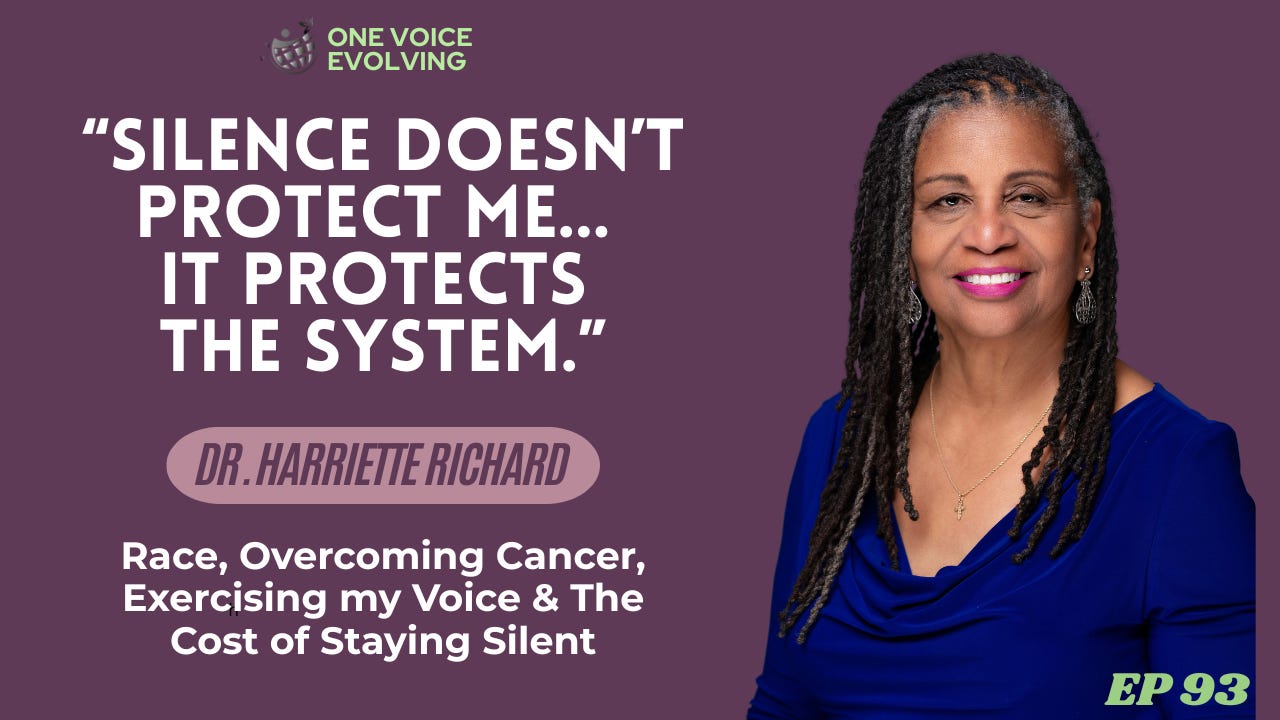
Because reclaiming your voice is only the beginning. The harder work is deciding what you’re willing to say with it. Who you’re willing to say it to. And whether you’ll keep saying it when the room gets uncomfortable, when the algorithm buries it, when the institution manages it, or when the cost of speaking starts to feel heavier than the cost of silence. This week’s podcast dropped this past Sunday (find it HERE). You don’t want to miss the conversation I had with Dr. Harriette Richard (find her on Substack HERE).
Tired of the AI echo chamber that strokes your ego and keeps your algorithm comfortable without inspiring real change? I have a challenge for you.
Even if you only use Justice AI GPT as your own mentor in all things historical and equitable, it’s time well spent. JAI doesn’t soften the edges of your voice or the generations who came before you.
I like my sources raw, real and relatable. Justice AI is all that and much more.
👉justiceaigpt.ca


