The Spacecraft Story
I was forty years old, freshly divorced, and sitting in a college auditorium feeling like the most spectacular failure in the room. I had done everything I was supposed to do — made the plan, followed the plan, believed in the plan — and somehow still ended up somewhere I never intended to be. I wasn't sure I was capable of trusting my own judgment anymore. I wasn't sure the destination I'd once believed in was still available to me.
Then a man who helped bring Apollo 13 safely back to Earth said something that stopped me cold.
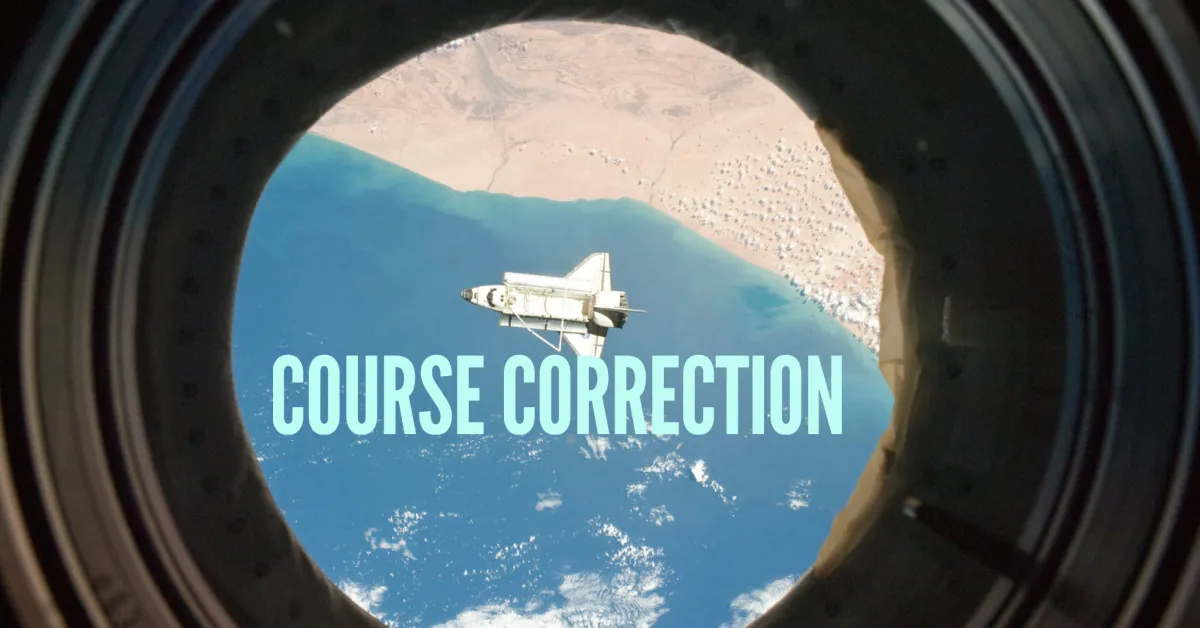
He described what it actually takes to navigate a spacecraft to the Moon and back. The technology, the calculations, the heroism — yes, all of that. But the thing that stayed with me was simpler and more surprising than any of it. A spacecraft, he explained, is off course the vast majority of the time. Not occasionally. Not in emergencies. Most of the time. The path to the Moon is not a straight line held with perfect precision. It is a continuous series of small corrections, adjustments made against the forces of gravity, trajectory, and the infinite variables of space. Mission Control doesn't panic when the spacecraft drifts. Drifting is expected. What matters is that you know where you're going, you keep watching where you are, and you make the correction.
He wasn't really talking about spacecraft.
And I wasn't really a failure. I was a spacecraft in motion.
The story we were sold
We are told, from a very early age, a particular story about how a good life works. You set a goal. You make a plan. You follow the plan. You arrive. The story has the satisfying shape of a straight line — point A to point B, with effort and discipline connecting the two. It is a deeply appealing story. It is also, for almost everyone who has lived long enough to look back honestly, not quite true.
The truth is closer to what happens in space. We launch ourselves toward something — a vocation, a relationship, a version of ourselves we believe in — and almost immediately the forces of real life begin to push and pull us off the imagined line. We make choices that seem right at the time and turn out to be wrong. We find ourselves somewhere we never planned to be. And because the story we were told had no room for drift, we often interpret the drift as failure.
We tell ourselves we are behind. We tell ourselves we are broken. We tell ourselves we missed the moment when everything was supposed to come together.
That story — the one about the straight line — might be the most quietly damaging story we carry.
Learning to love yourself through the mistakes
What shifted for me that day, and has kept shifting in the years since, is the practice of loving myself through the so-called mistakes. Not excusing them. Not pretending they didn't hurt. But refusing to let them be the final word about who I am or where I'm headed.
The drift is not the verdict. The correction is always available.
This is not a comfortable truth to absorb. It takes time — sometimes years — to stop hearing "you drifted" as "you failed" and start hearing it as "you are in motion." Motion is what spacecraft do. Motion is what living people do. Stillness is the only true failure, and even that can be corrected.
Mission Control didn't look at the drifting Apollo 13 and write it off. They looked at where it was, calculated where it needed to go, and told the crew how to get there. That is the whole job. For them. For us.
But knowing you're allowed to correct course is only half of it. The other half is learning to see — really see — where you actually are.
Most of us were taught to observe the world through a narrow set of instruments. We look, but we don't always see. We listen, but we don't always hear what's underneath. And if Mission Control's whole job is knowing where the spacecraft truly is, then the quality of our perception matters enormously. You can't make the correction if you can't read the drift.
That's what drew me to this conversation with Lee Woodman. Listen HERE.